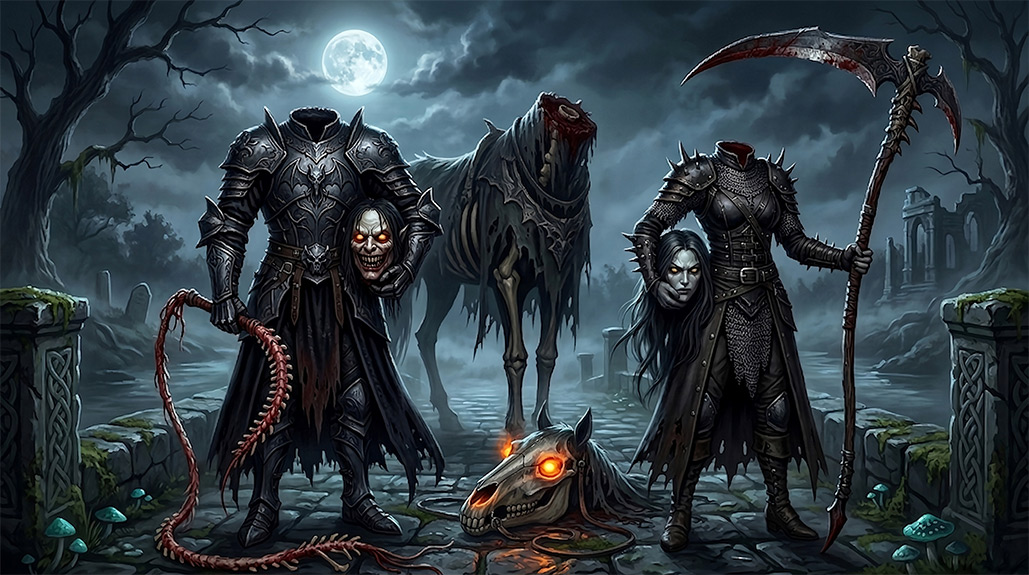
Dullahan
Origin & Overview
The Dullahan is the embodiment of terror, a headless rider who roams the misty roads to herald death. In the universe, they are often the reincarnated souls of ancient faerie guardians or cursed knights who refused to pass into the afterlife. Though frightening, they are not necessarily malevolent: many see themselves as the impartial psychopomps of the universe, ensuring the cycle of life and death with cold efficiency.
The Body and the Head
The Dullahan retains the appearance of a tall, pale, or sickly humanoid, often clad in long leather coats or heavy gothic armor plates. Their head, physically detached from their neck, rests under their arm or is strapped to their hip. They see, speak, and breathe normally through this severed head, whose skin sometimes resembles the texture of old parchment or cold wax. Their weapon of choice is a fearsome whip forged from a human spine.
Dullahan Names
Dullahans typically use the name from their former mortal life, albeit distorted by forgetfulness, which they pronounce in a guttural, hissing voice.
Names: Crom, Morrigan, Oengus, Rúadh, Cormac, Cathal, Fionnuala.
Racial Traits
You have the following racial traits.
Ability Score Increase. Your Strength increases by 2 and your Constitution by 1.
Age. Dullahans are trapped in a state of faerie undeath. They do not age.
Size & Weight. You stand between 6 and 7 feet tall, often weighing over 220 pounds. Your size is Medium.
Speed. Your base walking speed is 30 feet.
Creature Type. You are a Humanoid, allowing you to be healed by conventional spells. However, you count as both a Fey and an Undead for effects or spells that detect or repel these creature types (such as Detect Good and Evil or Turn Undead).
Languages. You can speak, read, and write Common and Sylvan.
Darkvision. Your eyes shine with a macabre glow. You can see in dim light within 60 feet as if it were bright light, and in darkness as if it were dim light.
Aversion to Gold. Dullahans have an irrational fear of gold. You have disadvantage on attack rolls made against a creature that is visibly wearing a piece of armor or a shield made of solid gold.
Removable Head. Your head is physically separated from your neck. You can hold it in your hands, strap it to your belt, or place it somewhere. You can see and hear from your head, regardless of its position, as long as it is within 60 feet of your body. If it is destroyed, your body is paralyzed until a magic equivalent to Greater Restoration regenerates it. If you are carrying your head, your body does not require a free hand for this; it is considered stowed in your equipment.
Spinal Whip. You are proficient with Whips. As a Bonus Action, you can extract a portion of macabre bone from your own body to create a Spinal Whip. This is a melee weapon (Reach 10 ft., Finesse) that deals 1d6 slashing damage. When you hit a creature, you can choose to convert that damage to necrotic damage.
Call of the Steed. The legend of the Headless Rider is not unfounded. As an action, you can summon the spectral remains of your steed, which appears in an unoccupied space within 5 feet of you. It uses the stat block of a Warhorse (Undead). You can ride it, gaining its speed of 60 feet and its abilities. It does not wear armor. It remains by your side for 1 minute, or until you dismount, or it drops to 0 hit points. Once this steed is summoned, you cannot do so again until you finish a long rest.