Origamar
Origin & Overview
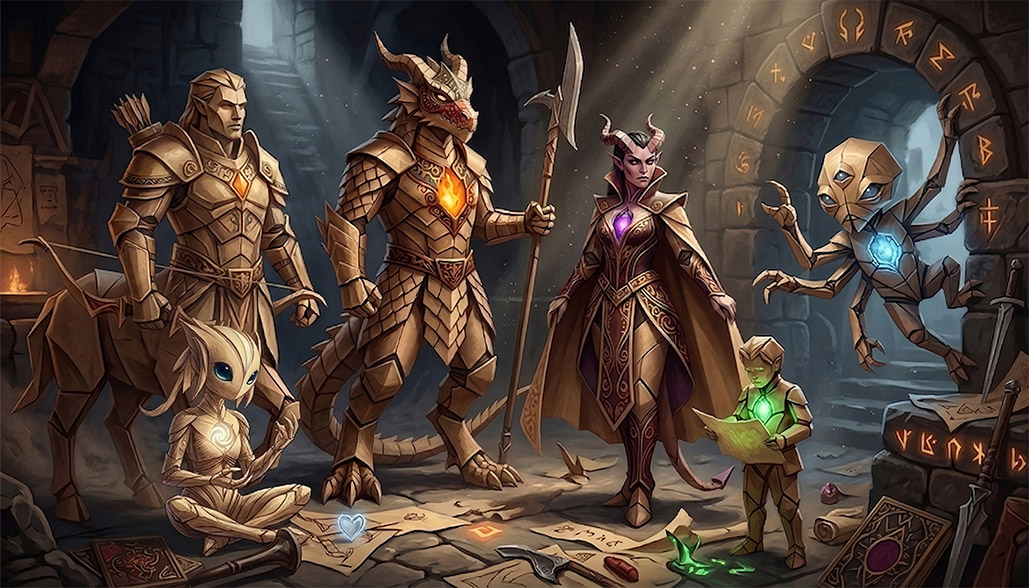
Origamars are creatures crafted from kraft paper, inspired by origami, taking on a roughly humanoid shape (arms, legs, head) with visible folds, stylized patterns, and most notably, a luminescent core nestled within their chest, visible through a cutout pattern in the paper. This core pulses with a faint glow and constitutes their vital essence. They were born in the magical forges of artisan mages or in the workshops of artifact makers, likely long forgotten, absorbing various sources of magic over time. Their paper bodies give them an appearance that is both light and fragile, but their magic makes them far more resilient than they seem.
A Paper Existence
Origamars are not born of flesh but of intention. Each individual is the result of a complex ritual where sacred geometry meets arcane magic. Originally simple servants or living archives created by master calligraphers and artisan mages, they eventually developed their own consciousness. Their bodies, though made of rigid kraft paper, possess a surprising fluidity. The folds that traverse their skin are not scars but the joints of their being, allowing for delicate expressiveness despite the absence of mobile facial features.
Social Relationships
Origamars are often perceived with curiosity or suspicion. People tend to treat them as fragile objects, a mistake that the Origamar quickly dispels with their magical resilience. They particularly get along well with Gnomes (due to their love of craftsmanship) and Forgelings (with whom they share an artificial nature), but find "wet" and "messy" races somewhat difficult to understand.
Personality and Culture
Each Origamar views their body as a work of art: each fold represents a lesson, each pattern a memory. Some redraw their patterns as they evolve, much like others change their clothing. The "long folds" are often the builders and protectors of their people, while the "short folds" excel in exploration, creation, and stealth. Their voice has a slight rustle, like a delicate crumpling when they speak.
Origamar Names
The names of Origamars are often based on sounds of texture, geometric shapes, or concepts related to writing and structure. They generally do not distinguish gender in their names.
Names: Plis, Grimoire, Scribe, Angle, Kraft, Bruisse, Sceau, Fibre, Trame, Verso, Orig, Cise, Point-Sèche, Ambre-Cœur.
They may also be named based on the environment in which they come to life or a name they heard during their awakening.
Racial Traits
You have the following racial traits.
Ability Score Increase. When you create your character, increase one ability score of your choice by 2 and a different score by 1, or increase three different ability scores of your choice by 1. These increases can't raise an ability score above 20.
Age. Origamars complete their initial folding around the age of 5, reach their full size by 20, and can live up to 150 years or more, as long as their core remains intact.
Size & Weight. Choose your folding when you create your character. Long folds, called Origamara, are Medium size and stand between 5 feet and 6 feet 3 inches tall. Short folds, called Origamari, are Small size and stand between 2 and 3 feet tall. This choice is permanent unless another effect transforms you. Your body weighs between 2 and 11 pounds, depending on your folding; this weight doesn't include your equipment.
Speed. Your base walking speed is 30 feet. Light Body allows you to glide when falling, but doesn't give you a flying speed.
Creature Type. You are a Humanoid. Your paper body and core are artificial in nature, but don't grant you the Construct type or any immunities it might have. Your core is part of your body; it isn't a separate target with its own hit points.
Paper Nature. You have resistance to poison damage, advantage on saving throws to avoid or end the poisoned condition, and immunity to disease. You don't need to eat, drink, or breathe. Having a paper body doesn't give you vulnerability to fire or water.
Core Rest. You don't need to sleep. You can finish a long rest by spending 4 hours motionless and conscious, doing nothing other than perceiving your surroundings. You follow all the other rules for a long rest. You can still be put to sleep by magic.
Languages. You can speak, read, and write Common and one additional exotic language of your choice, with the DM's approval for that language.
Darkvision. Your magical core allows you to see in dim light within 60 feet as if it were bright light, and in darkness as if it were dim light. In darkness, you can only perceive shades of gray. This sense doesn't require your core to illuminate your surroundings.
Light Body. When you start falling at least 10 feet above the ground, you can use your reaction to unfold your body. You can then move horizontally up to 20 feet during that fall and take no damage at its end. You choose the direction of this movement, which doesn't allow you to rise or remain aloft. You can use this trait only once during the same fall. If you can't use your reaction, the normal falling rules apply.
Paper Body. As an action, you can flatten and refold your body for 1 minute. Your size becomes Small if you are normally Medium, or Tiny if you are normally Small. Your speed doesn't change. Your core flattens with your folds: you can pass through an opening at least 1 inch wide. This passage doesn't require the extra movement normally associated with squeezing.
Your integrated equipment folds with you. Any item you hold or wear without having integrated it retains its shape and must be able to pass through the opening separately. Your total weight and carrying capacity remain those of your normal form. In this form, you can't take actions, bonus actions, or reactions, or speak. You remain a creature, retain your other statistics, and can maintain concentration under its normal rules. You have advantage on Strength (Athletics) and Dexterity (Acrobatics) checks needed to climb or squeeze during your movement; this trait doesn't give you a climbing speed or automatically free you from a restraint or grapple.
You can end this form without using an action at the start of your turn. It also ends if you are incapacitated. If you lack the space needed to return to your normal size, you remain compressed, with the same limitations, until you reach a space large enough. This extension doesn't allow you to enter a new opening that your normal form couldn't pass through.
Armor Absorption. You don't don armor in the conventional way. You can integrate a suit of armor with which you are proficient and that you touch into your folds. Integrating and removing it take the normal times for donning and doffing that armor. It must remain in contact with you throughout that time. You can integrate only one suit of armor at a time; removing a suit of armor makes it reappear in its current condition at your feet before you integrate another.
You can also integrate items normally worn on the body, such as a cloak or boots, taking the time normally required to put them on or take them off. Weapons, shields, items that must be held, and containers can't be integrated. You use them normally with your hands or carry them externally.
An integrated item is considered worn: it retains its weight for your carrying capacity, proficiency requirements, Strength or Stealth penalties, attunement requirements, and usage limits. The normal limits on wearing items simultaneously apply; integration doesn't allow you to combine multiple suits of armor or items that are normally incompatible. Integrated items remain perceptible as patterns and are considered visible and worn for effects that target them, such as Heat Metal. In particular, integrated armor counts as worn armor for abilities that require you to wear no armor.
When you die, all integrated items reappear in your space, in their current condition. Integrating them neither repairs them nor makes them indestructible.