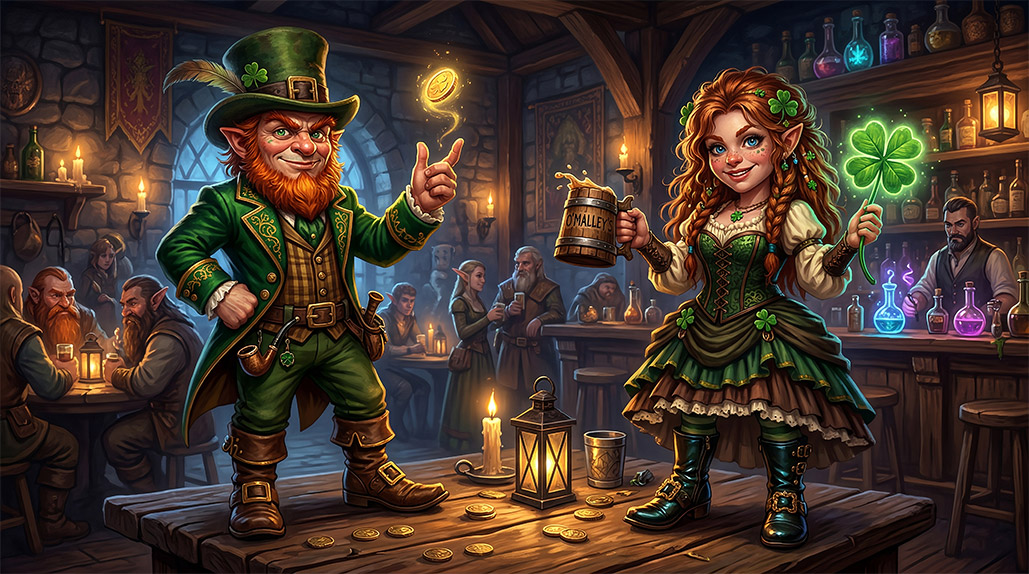
Leprechaun
Origin & Overview
Leprechauns are small faeries known for their mischief, love of craftsmanship, and, of course, their visceral obsession with gold and wealth. They are beings deeply rooted in the mysticism of probability and chance. They often travel to the mortal realm for the sheer joy of playing tricks, conducting business, or reclaiming treasure that has been stolen from them.
The Art of Mischief and Style
About the size of a halfling, a Leprechaun often has impish features, eyes sparkling with mischief, and (for males) surprisingly abundant facial hair for such small creatures. They dress with flamboyant elegance: frock coats, top hats, golden buckles, and velvet fabrics in emerald or brown tones. Appearance is of utmost importance in their culture, with every detail of their attire reflecting their love for beautiful things.
Leprechaun Names
Their first names are derived from Gaelic and Celtic roots, often accompanied by a nickname that reflects their most annoying trait or their greatest pride in craftsmanship.
Names: Seamus, Finnegan, Oisín, Declan, Padraig, Maeve, Siobhán, Niamh, Róisín.
Nicknames: Full-Purse, Quick-Fingers, Sly-Grin, Golden-Tongue, Polished-Boot.
Racial Traits
You have the following racial traits.
Ability Score Increase. When you create your character, increase one of your ability scores by 2 and a different score by 1, or increase three different scores by 1. These increases can't raise an ability score above 20.
Age. Leprechauns live extremely long lives in the Feywild, often for several centuries, although time flows differently for them.
Size & Weight. You stand about 3 feet 3 inches tall and weigh around 33 pounds. Your size is Small.
Speed. Despite your short legs, your base walking speed is 30 feet.
Creature Type. You are a Fey creature.
Languages. You can speak, read, and write Common and Sylvan.
Leprechaun Magic. You know the minor illusion cantrip. Starting at 3rd character level, you can cast invisibility as a 2nd-level spell, targeting only yourself, without expending a spell slot. Once you cast it in this way, you must finish a long rest before you can cast it again with this trait. Charisma is your spellcasting ability for these spells. You must provide their normal components and follow the normal spellcasting rules, including concentration. This trait does not grant additional castings by expending spell slots, and does not limit castings allowed by another ability.
Merchant's Charm. The magic of contracts and transactions flows through your veins. You are proficient in the Persuasion skill. Additionally, when you bargain for the purchase or sale of a tangible item with a creature outside combat, you have advantage on Charisma (Persuasion) checks to obtain a discount or a better price. This trait does not impose a price, force a creature to trade, or allow you to repeat a check without a change in circumstances.
Coin of Fate. You are intimately connected to the laws of chance and karma. When an attack or spell would deal damage to you, you can use your reaction after learning the amount, but before taking the damage, to flip a magical coin: roll 1d4.
- Even result, Heads. Luck turns against you. Add 1d6 force damage to the triggering damage, as part of the same instance of damage. This die is not doubled by a critical hit. Your resistances and vulnerabilities apply separately to each damage type. This additional damage cannot trigger another use of this trait.
- Odd result, Tails. Luck smiles upon you. Reduce the triggering damage by 2d6 + your proficiency bonus, to a minimum of 0. This reduction applies before your resistances and vulnerabilities. If multiple damage types are dealt simultaneously, divide the reduction among those types as you wish.
The reaction affects only one instance of damage: it does not protect against other attacks in a multiattack or later damage from the same spell. You can use this trait a number of times equal to your proficiency bonus, and you regain all expended uses when you finish a long rest.