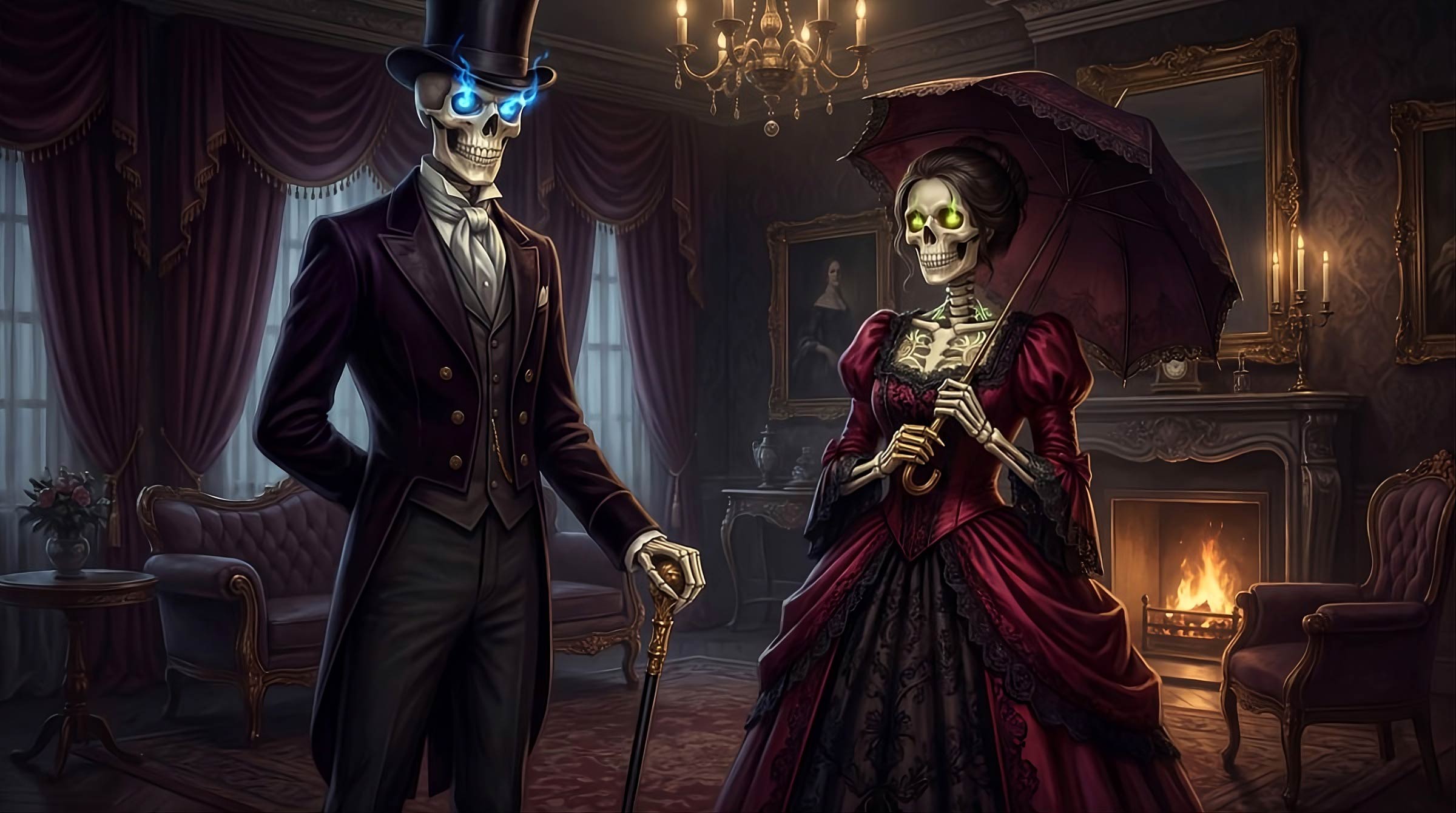
Exuvar
Origin & Overview
The etymology of the word "exuviae" refers to the skin shed by an animal during molting. The Exuvar is the unsettling manifestation of this phenomenon applied to the soul and body of a humanoid. Records from thaumaturges indicate that this is neither a classic resurrection nor a lowly necromantic curse, but rather a ritual of "spiritual molting." At the moment of death, the individual sheds the burdens of flesh, muscle, and blood, retaining only the skeletal structure, purified and inscribed by the magic of the soul.
The result is a conscious undead, liberated from physical pain and physiological constraints. Culturally, Exuvars often develop a philosophy of the absurd, laughing in the face of nothingness. Having lost their vocal cords, they communicate through magical resonance emanating from their ribcage. They cultivate a keen sense of fashion, dressing in extravagant elegance to contrast with the nakedness of their bones.
Unlike skeletons reanimated by mere necromancers, Exuvars retain the full capacity of their former personalities. They move with a light, bouncy gait, almost defying gravity, their bones whitened with lime or polished like ivory, clattering to the rhythm of an inaudible melody.
Mortally Elegant
An Exuvar is a majestic skeleton. Without the mass of flesh, they appear unnaturally slender and elongated. The empty eye sockets of their skull sometimes glow with small ethereal flames of blue or green, reflecting their emotions, widening in shock or crinkling with laughter. Some Exuvars etch luminescent runes or floral patterns directly onto their bones, or replace lost phalanges with prosthetics made of gold or precious wood. Their lipless jaws seem fixed in a perpetual smile, reinforcing their laid-back attitude in the face of danger.
Note: Wearing armor and equipment is not a hindrance for this race. You wear your gear just like any other humanoid race.
Exuvar Names
Exuvar names are chosen freely at the time of their Spiritual Molting ritual. As they shed the burdens of mortal life and flesh, they categorically reject their former identities. Their new names reflect their philosophy of the absurd and are heavily inspired by musical lexicon, theatrical vocabulary, or purely ironic references to their new anatomical condition.
Musical and artistic inspiration names: Maestro, Sonate, Requiem, Tempo, Rhapsodie, Arpège, Symphonie, Cadence, Octave, Chœur, Carillon.
Anatomical and macabre names (embraced with irony): Cliquetis, Phalange, Rictus, Calavera, Osselet, Ivoire, Trépas, Fémur, Vertèbre, Sépulcre, Carcasse.
A very common and appreciated cultural practice among Exuvars is to retain (or invent entirely) an extremely grandiose human title of nobility. They attach this title to their new name to create a humorous contrast between the extravagance of aristocracy and the absolute nudity of their bones.
Examples of full names: Duke Cliquetis, Lady Phalange, Baron Rictus, Countess Sonate, Lord Trépas, Marquis Arpège.
Racial Traits
Though you are an animated skeleton, the magic of Spiritual Molting maintains the integrity of your living nature.
You have the following racial traits.
Ability Score Increase. Your Dexterity increases by 2 and your Charisma by 1.
Age. Exuvars do not age, but erosion will eventually take its toll on their bones after 800 to 1000 years.
Size & Weight. Your size is Medium, and you weigh less than 15 kilograms.
Movement Speed. Your base speed is 10.5 meters, and your swimming speed is 3 meters.
Creature Type. Your creature type is Humanoid, allowing you to be targeted normally by divine healing spells.
Languages. You can speak, read, and write Common and two other languages of your choice. You may choose to replace the two other languages with an exotic language by rolling dice.
Purified Anatomy.
-
You are immune to diseases.
-
You have advantage on saving throws against the Poisoned condition, and resistance to poison damage.
-
You do not need to sleep, drink, eat, or breathe.
-
To benefit from the effects of a long rest, you spend 4 hours in a state of conscious immobility, during which you gather the magical energy that binds your bones.
Sepulchral Lightness. Weighing barely more than a bundle of dry wood, inertia affects you differently. If you move at least 3 meters in a straight line during your turn, you can traverse the surface of a liquid without sinking for the rest of your movement, gliding on the water due to your lightness. If you end your movement on the liquid, you sink normally. However, your physique does not allow you to swim properly. Your swimming speed is 3 meters, and you cannot be stealthy while swimming.
Inanimate Molting. You can simulate your own death with unsettling perfection. As an action, you can collapse to the ground, slightly scattering your bones. The equipment you are wearing falls to the ground or remains attached to your body when possible. As long as you remain motionless, you are indistinguishable from a true pile of bones or an ancient corpse. A creature that actively inspects you must succeed on an Investigation (Intelligence) check against a DC equal to 8 + your Dexterity modifier + your proficiency bonus to perceive the magical flow that binds you.