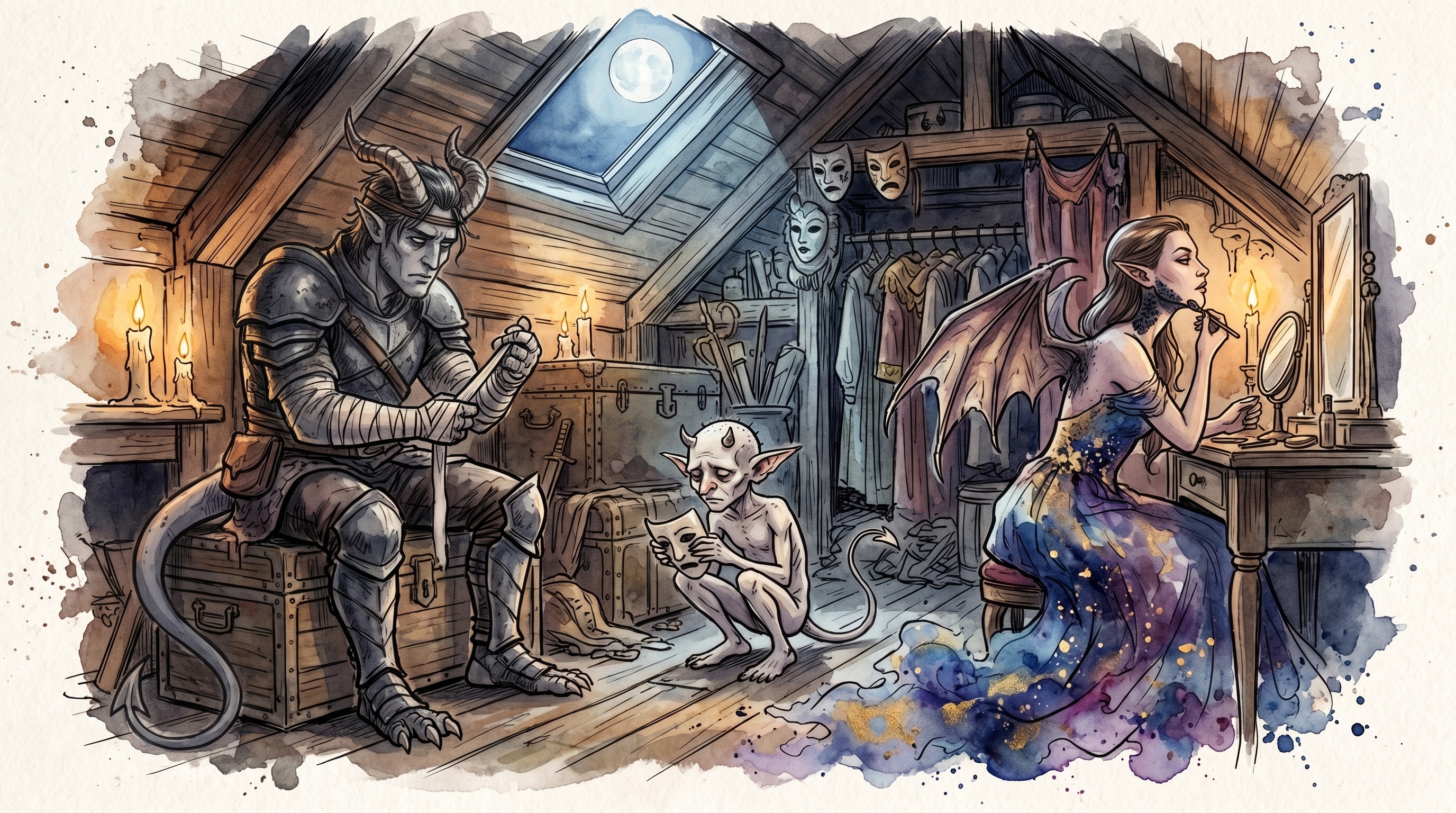
Castoff
“I know this isn’t my face. But I’m still the one who helped you.”
— Vexis, in the guise of a brass dragonborn.
Origin & Overview
Born malformed, a Castoff has been rejected by their creators, masters, or some higher authority. Many come from the Nine Hells or the Abyss, but their stories can begin elsewhere: an unfinished magical creation, the servant of a cruel fey power, or the despised offspring of an extraplanar being.
Their masters spared their lives to exploit them. Espionage, thankless errands, manipulation, cruel entertainment, and dangerous tasks have taught Castoffs to make themselves useful to those who scorn them. Some still serve their former masters; others try to escape, knowing that those masters may seek to reclaim them.
Behind each borrowed face lie the fear of discovery, the need for acceptance, and the hope of building an identity of their own choosing. A Castoff might be shy, cunning, proud, devoted, resentful, or ambitious. Their past need not determine who they become.
A witness’s rejection never causes automatic banishment. A companion’s acceptance can stabilize a Castoff’s embodiment without ever compelling obedience.
An Almost Perfect Appearance
A Castoff’s true form retains the broad features of their origin, but their anatomy is unusual, disproportionate, or incomplete. No single true appearance is shared by all Castoffs.
Their defining gift, Embodiment: False Visage, allows them to adopt an almost perfect appearance belonging to another race of the same size category. A visible physical anomaly always remains. The Castoff tries to conceal it or explain it away: beneath their chosen face, some part of their origin endures.
Castoff Names
Masters sometimes give their servants humiliating names. A free Castoff may keep such a name, reclaim it, or choose a new one.
Imposed Names: Rature, Débris, Bavure, Rebut.
Chosen Names: Vexis, Aube, Nacre, Silex, Écho, Lior.
Racial Traits
Your character has the following traits. Your origin and embodiments grant you no racial traits other than those expressly described here.
Ability Score Increase. Increase one ability score by 2 and a different score by 1, or increase three different ability scores by 1.
Age. How you mature depends on the circumstances of your birth or creation. Castoffs can generally live for up to two centuries. Embodiment does not change your actual age.
Size. Choose Small or Medium when you create your character. This choice applies to your true form and all your embodiments. Determine your original weight and proportions with your DM.
Speed. Your base walking speed is 30 feet.
Creature Type. You are a Humanoid. Your origin does not grant you a second creature type.
Languages. You can speak, read, and write Common and one language appropriate to your origin, chosen with your DM, usually Infernal or Abyssal.
Impostor’s Instinct. You have proficiency in the Deception skill and with the disguise kit.
Embodiment: False Visage
By spending 1 minute transforming, you can adopt the appearance of a member of a playable race allowed in the campaign. That race must be of your size category, and you must have observed a member of it before.
You choose the details of this appearance: facial features, coloration, hair, voice, and proportions. Your gait and gestures can match those of your model. You can also imitate an individual you have observed, but you gain none of that individual’s memories, knowledge, or languages.
This magical transformation physically alters your appearance. Touch alone does not dispel it. It changes neither your clothing nor your equipment.
Your game statistics remain unchanged, except for any benefit granted by Minor Mimicry. Any wings, tails, or additional limbs you reproduce are decorative: they cannot be used to fly, grasp an object, or make additional attacks. Nor does your body acquire the properties of wood, stone, paper, or any other material it imitates.
You retain this appearance until you adopt another, use an action to return to your true form, or die. Sleeping or falling unconscious does not end your Embodiment.
Persistent Imperfection
Every embodiment has a physical anomaly that is clearly visible when exposed. Define it with your DM the first time you use that appearance. The anomaly remains the same whenever you return to that embodiment.
The anomaly must be conspicuous enough to draw attention: half your face might retain your original skin, one hand might visibly belong to a different kind of body, or a large patch of skin might lack the expected scales. A feature hidden inside your body or an almost imperceptible detail does not qualify.
This anomaly imposes no additional physical penalty.
You can cover it with appropriate clothing. If it is completely concealed beneath opaque fabric, it cannot be seen through that fabric.
You can also spend 10 minutes using a disguise kit to camouflage it, if the nature of the anomaly allows. This camouflage withstands casual observation. A creature that examines it closely can detect it with a successful Intelligence (Investigation) check against a DC equal to 8 + your proficiency bonus + your Charisma modifier. In combat, this examination requires an action.
You must reapply the camouflage after each long rest, after changing your embodiment, or if it is removed or sufficiently damaged. It can never physically conceal something that the materials used cannot cover.
Discovering the anomaly reveals a physical inconsistency; it does not automatically identify you as a Castoff. You can still try to explain it, subject to Brand of Rejection.
Minor Mimicry
When you finish a long rest, choose a race you know how to embody and one eligible benefit from the following table.
Until your next long rest, you gain that benefit only while your embodiment represents the chosen race. Changing your appearance does not allow you to select a new benefit.
| Benefit | Effect |
|---|---|
| Borrowed Sight | If the race has darkvision, you gain darkvision out to 60 feet, or to the race’s normal range if it is shorter. Within that range, you see dim light as bright light and darkness as dim light, in shades of gray. This benefit does not extend any darkvision you already have. |
| Adapted Movement | If the race has a swimming speed or a climbing speed, you gain one of those speeds, to a maximum of 30 feet. You gain neither the ability to breathe underwater nor the ability to cling to surfaces or walk on ceilings. |
| Practiced Mannerisms | Regardless of the chosen race, you gain proficiency in one of the following skills: Acrobatics, Intimidation, Persuasion, or Performance. This proficiency represents the mannerisms you have learned to inhabit that identity. |
You can gain only one of these benefits at a time. You gain no other traits from the imitated race.
Warmth of Acceptance
When you finish a long rest spent in the company of at least one ally who knows your true nature and freely accepts you, you gain temporary hit points equal to your character level + your proficiency bonus.
That ally must have shared your resting place and be within 30 feet of you when you finish the rest. Acceptance compelled by a charm or magical control does not meet this requirement.
These temporary hit points follow the normal rules: they do not add together with other temporary hit points, and they last until depleted or until you finish your next long rest. Your ally moving away afterward does not remove them.
Brand of Rejection
The mark left by your former masters prevents you from defending an embodiment indefinitely once its imperfection has been discovered.
When a creature that can actually see your anomaly asks you a direct, specific question about it, you must give a truthful answer if you can hear and understand the question and are able to speak. This obligation concerns the question asked about your anomaly; it does not compel you to recount your entire history.
If, within the next minute, a creature that heard and understood your answer directly asks whether you truly belong to the race you claim to be, your Embodiment ends as soon as you hear and understand this second question.
You return to your true form and cannot use Embodiment: False Visage for 1 minute. You lose the benefit of Minor Mimicry during this time.
In combat, a creature must use an action for this confrontation to trigger the revelation, even if it has already heard your initial admission. A creature that has already seen your true form can no longer trigger this revelation through this trait.
Voluntarily revealing your true form does not trigger this restriction.
An Outstretched Hand
During the 1-minute restriction imposed by Brand of Rejection, an ally within 30 feet of you who can see your true form and whom you can hear can use their reaction to sincerely express their acceptance of you.
The restriction on using Embodiment immediately ends. You can then resume the appearance you just lost without using an action.
No oath of obedience is required. You may offer one as part of your story, but this trait gives no one control of your character.
Variant: Tiny Castoff — with the DM’s approval
With your DM’s approval, you can choose to be Tiny when you create your character. You can then embody only members of Tiny playable races allowed in the campaign.
Your carrying capacity is halved, and your space in combat is 2½ feet by 2½ feet.
For this variant, weapons sized for you retain their normal statistics, and you count as Small for the heavy weapon property. Your normal reach remains 5 feet.