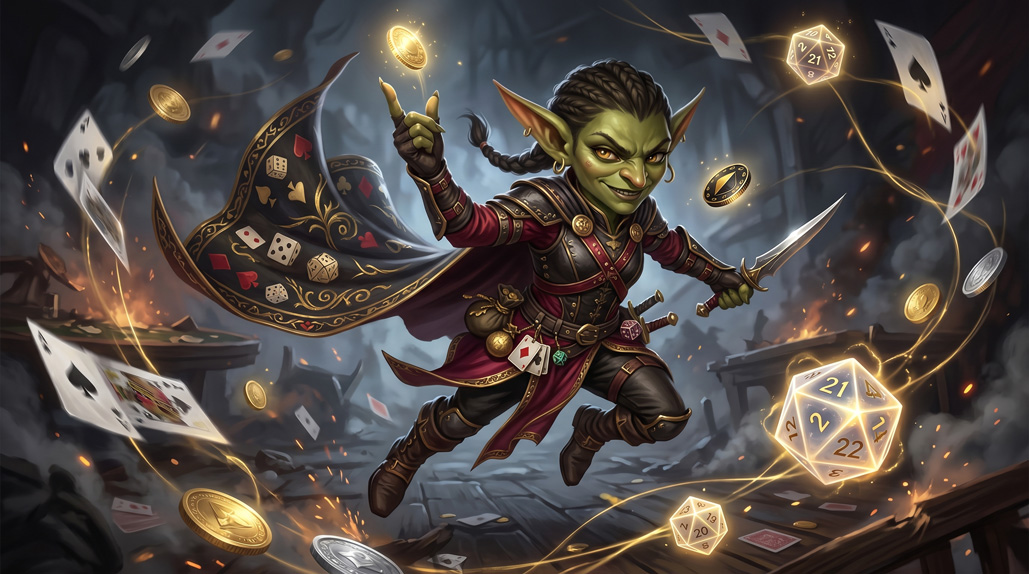
High Roller
Some rogues rely on shadows; others on their blades, their words, or their magic. High Rollers rely on luck—or at least on the art of making luck believe it has a choice.
A High Roller approaches life like a gambling table: a smile on their lips, a coin between their fingers, a loaded die up their sleeve, and a backup plan behind every wager. They know chance is real, but they also know a true gambler never lets chance play alone.
For these rogues, every strike is a stake, every dodge a wager, every lie a hidden card. They do not merely seek to survive misfortune: they seek to steal it.
Rogue Subclass: High Roller
Fortune Stakes
3rd-level Rogue feature
You learn to give your luck physical form as coins, tokens, marked cards, or loaded dice called Fortune Stakes.
You have a number of Fortune Stakes equal to your proficiency bonus + your Dexterity modifier, with a minimum of 1. You regain all expended Fortune Stakes when you finish a long rest. A short rest does not replenish them. Your proficiency bonus is based on your character level; the levels given in the features below are your Rogue levels.
Your Fortune Stakes are not actual gold pieces, though you can represent them with real coins, cards, or dice at the table. They represent your daring, your instincts, and your ability to nudge chance in the right direction.
Spending a Fortune Stake requires no action beyond any action specified by the feature. A spent stake remains lost whether the wager or roll succeeds or fails. You can use Impossible Dice only once on the same d20 roll; other Fortune Stake expenditures, such as a wager on an attack's damage, are separate.
Each wager uses a fair coin. Alternatively, you can roll 1d6: an even result counts as tails, and an odd result counts as heads. Effects that modify an attack roll, ability check, or saving throw do not modify these coin flips or d6 rolls.
In addition, you gain proficiency with two gaming sets of your choice, such as dice, playing cards, dragonchess, or Three-Dragon Ante. Your proficiency bonus is doubled for ability checks that use either of these two proficiencies; it cannot be doubled a second time. This feature guarantees neither victory at a game nor the presence of opponents or monetary stakes.
Blade's Wager
3rd-level Rogue feature
When your blade finds an opening, you can stake your luck on an impossible strike.
Once per turn, when you hit a creature with an attack using a finesse weapon or a ranged weapon and apply your Sneak Attack to that attack, you can spend 1 Fortune Stake to make a wager. You decide before rolling damage. This feature does not let you apply Sneak Attack a second time during the same turn.
Choose heads or tails before flipping the coin. You win if the result matches your choice.
If you win the wager, the attack deals extra damage based on your Rogue level, as shown in the table below.
| Rogue Level | Extra Damage |
|---|---|
| 3rd | 1d6 |
| 9th | 2d6 |
| 13th | 3d6 |
| 17th | 4d6 |
This extra damage is of the same type as the weapon's damage. If more than one type is possible, choose one of them. Its dice are doubled on a critical hit, as are your Sneak Attack dice.
If you lose the wager, the attack deals its normal damage, including Sneak Attack. You lose the stake but keep your reaction.
Double or Nothing
9th-level Rogue feature
Your luck does more than protect you when you strike: sometimes it saves you at the last instant, when an enemy's blade should already have found its mark.
When you use Uncanny Dodge to reduce the damage of an attack that hits you, you can spend 1 Fortune Stake to turn that dodge into a wager. You make this choice after learning the damage, but before taking it. This feature uses the same reaction as Uncanny Dodge and retains all its requirements, including seeing the attacker.
The attacker, or the DM on its behalf, chooses heads or tails. Then flip the coin. This choice does not require the attacker to hear you or understand a language.
If the result does not match the attacker's choice, it loses the wager: divide each type of the attack's damage by four instead of dividing it by two with Uncanny Dodge.
If the result matches its choice, it wins the wager and your Uncanny Dodge works normally. Round fractions down; resistances and vulnerabilities then apply normally to each damage type. Dividing by four replaces the division from Uncanny Dodge rather than adding to it. This wager protects only against the attack that triggered the reaction.
Cheating Fate
When the creature wins this wager, you can try to rig the result at the last instant by sacrificing some of your personal wealth.
Without using an additional action, you can sacrifice real, nonmagical coins that belong to you and that you are carrying, with a value in gold pieces equal to:
5 × your Rogue level × your proficiency bonus × the number of times you have paid for Cheating Fate since your last long rest, including this payment.
If you pay this cost, you turn your loss into a win: apply the division by four described in Double or Nothing. The payment counter resets to zero at the end of your next long rest.
Coins spent this way are lost. They might be tossed away, broken, blackened by ill luck, offered to fate, or simply vanish amid the impossible coincidences that surround your art. They cannot be recovered.
A promise to pay, a valuable object, or Fortune Stake tokens cannot replace these coins. If you are not carrying the full amount, you cannot pay and Uncanny Dodge remains unchanged. Carrying less money does not reduce the price. This payment requires no free hand and grants neither a new reaction nor another use of Uncanny Dodge.
Impossible Dice
13th-level Rogue feature
You have learned to roll dice that should not exist: dice with twenty-one sides, twenty-two sides, or perhaps just ordinary dice no one has ever managed to read correctly.
When you flip a coin for a feature of this subclass, you can flip two coins instead of one and choose whichever result you prefer, after announcing the heads-or-tails choice required by that wager. If you use dice instead, roll two d6s and choose one. This improvement applies only to this subclass's wagers, not to the d4 described below or to features of a race or another class.
In addition, when you make an attack roll, ability check, or saving throw, you can spend 1 Fortune Stake after determining which d20 result is used, including after rerolls and advantage or disadvantage, but before the DM announces whether the roll succeeds or fails.
Roll 1d4 and apply the following result to the roll:
| d4 | Effect |
|---|---|
| 1 | Subtract 2 from the roll. |
| 2 | Subtract 1 from the roll. |
| 3 | Add 1 to the roll. |
| 4 | Add 2 to the roll. |
This modifier can turn a failure into a success or a success into a failure.
This modifier applies to the roll's total, after other applicable features such as Reliable Talent. It does not change the natural result of the d20: the special effects of a natural 1 or 20, notably on an attack roll or a death saving throw, remain unchanged. It grants neither advantage nor disadvantage and does not let you use this feature again on the same roll.
Jackpot
17th-level Rogue feature
You know the perfect moment: when the world holds its breath, the coin spins in the air, and fate waits to learn who truly holds the cards.
Once per turn, when you hit a creature with an attack using a finesse weapon or a ranged weapon and apply your Sneak Attack to that attack, you can declare a Jackpot before rolling damage. You cannot declare it if the attack is already a critical hit.
When you declare a Jackpot, spend 2 Fortune Stakes and choose heads or tails. Thanks to Impossible Dice, flip two coins and choose one of their results. You win the wager if the chosen result matches your announced choice.
If you win the wager, the attack becomes a critical hit and follows all the normal rules for critical hits. This result does not turn the d20 into a natural 20 and does not bypass a protection that prevents the target from suffering a critical hit.
If you lose the wager, the attack hits normally, but you halve its damage of each type, including Sneak Attack and modifiers, rounding down. The target's resistances and vulnerabilities then apply normally. An effect of the attack that does not depend on its damage is not removed by this division.
You cannot use Blade's Wager and Jackpot on the same attack.
Blade's Wager and Jackpot can accompany an attack made during another creature's turn if it meets their requirements, without granting you an additional attack or reaction. They never waive the requirements of Sneak Attack.